"A Spectacular Success": The birds of Cook County
Northwestern's bird species illustrate stories of recovery
March 1, 2026
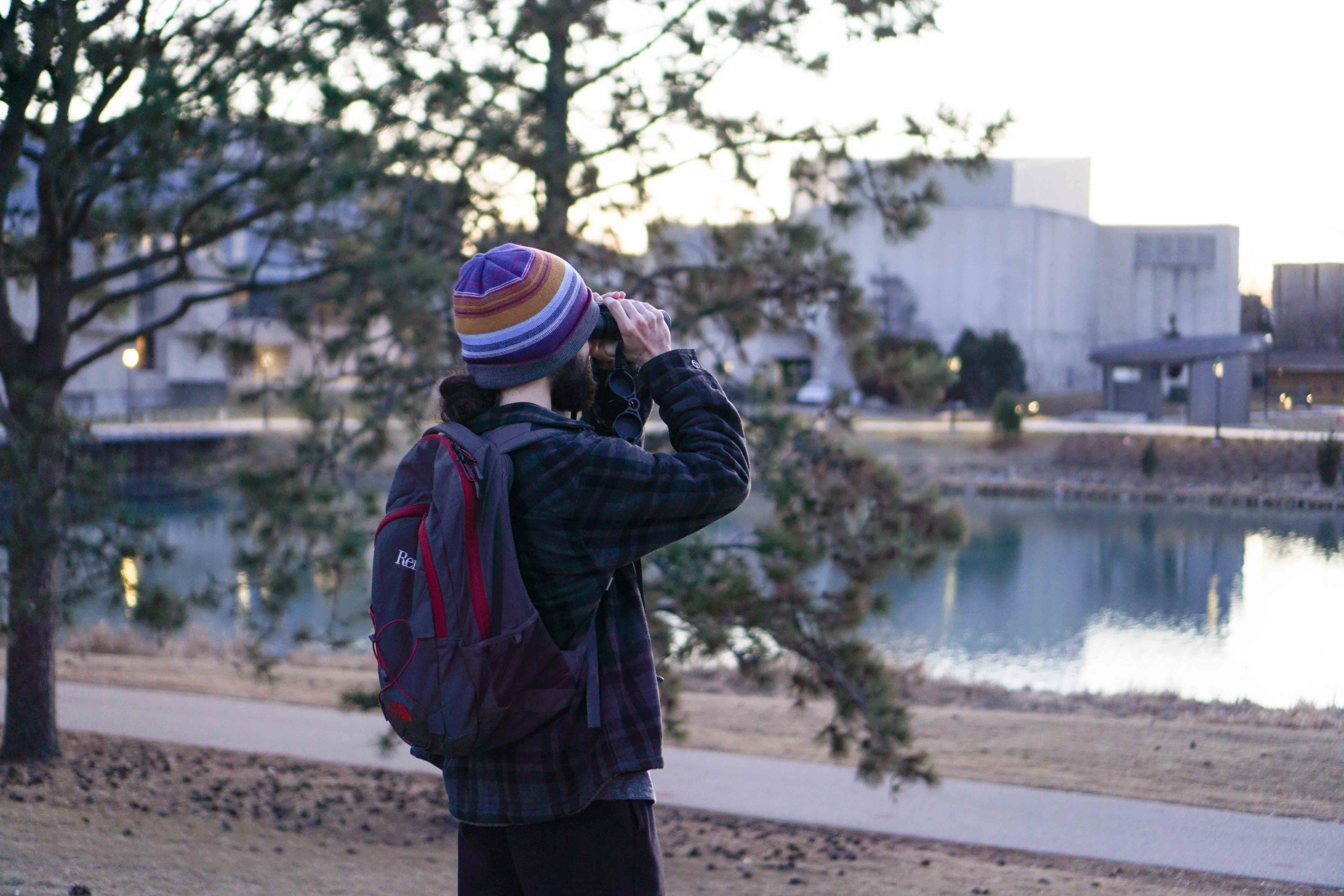
On a warm February evening, Weinberg senior Alex Boyko stood on a small hill on Northwestern’s Lakefill, a pair of binoculars held to his eyes.
“We have some migratory ducks on the lagoon right now,” Boyko said. “I'm going out to take a look at those.”
In 45 minutes, Boyko counted 63 individual birds and 19 species. Among them were 10 Canada geese, six hooded mergansers, one common merganser and two buffleheads.
“This is a beautiful area on campus — there's a lot of biodiversity,” Boyko said. “It (bird watching) is a good way to recharge after a busy day, to go out and spend some time with nature.”
There have been 490 unique bird species spotted in Cook County, according to eBird data. Bird watchers have recorded bird sightings in practically all corners of the county, with Montrose Point Bird Sanctuary and Northwestern University proving to be particularly fruitful locations.
One bird in particular has gained what Field Museum’s senior conservation ecologist Doug Stotz described as a “love-hate relationship” — the Canada goose.
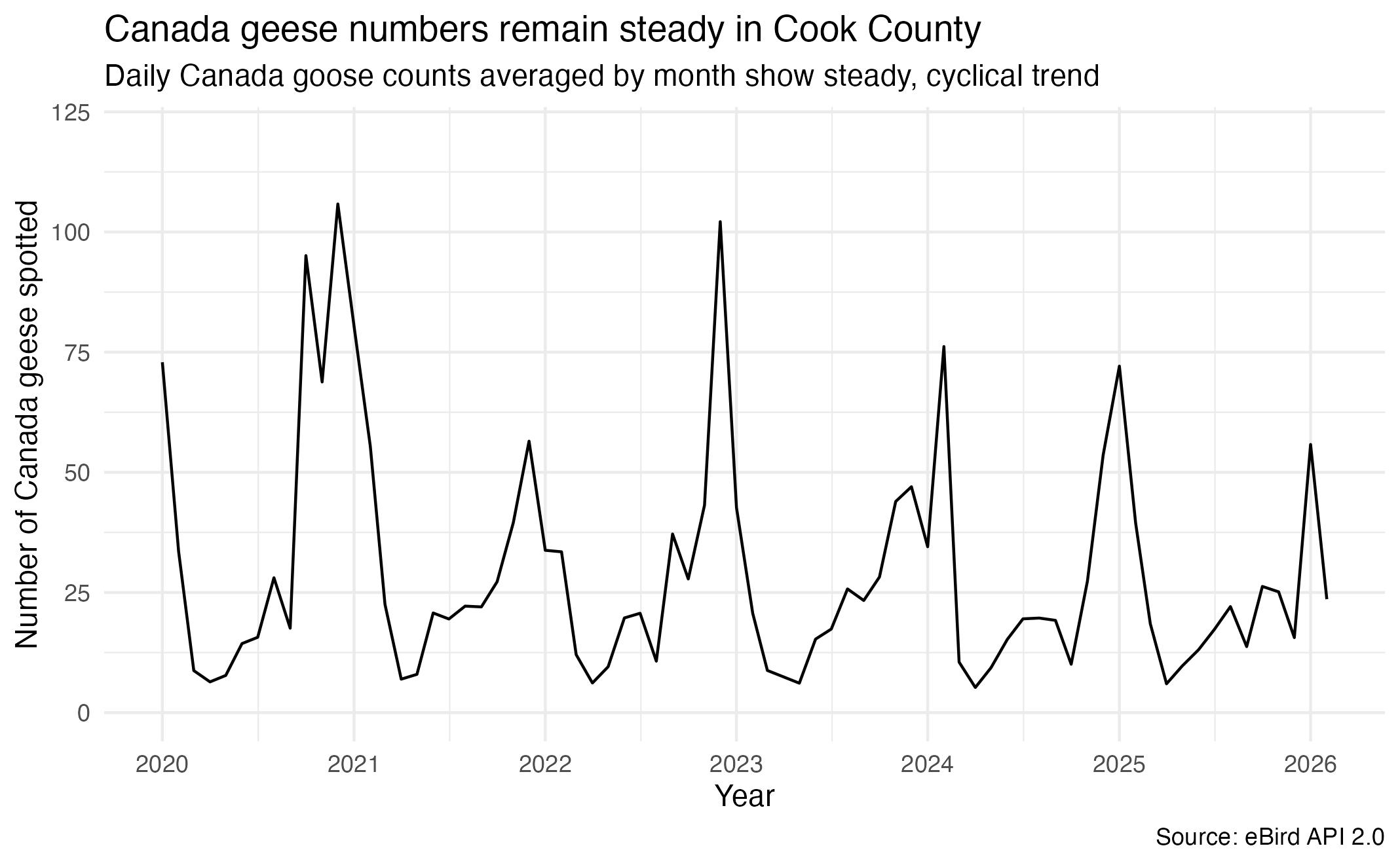
Canada goose numbers in Cook County have been holding steady — for the past five years, bird watchers have spotted an average of 29 geese a day around the shores of Lake Michigan.
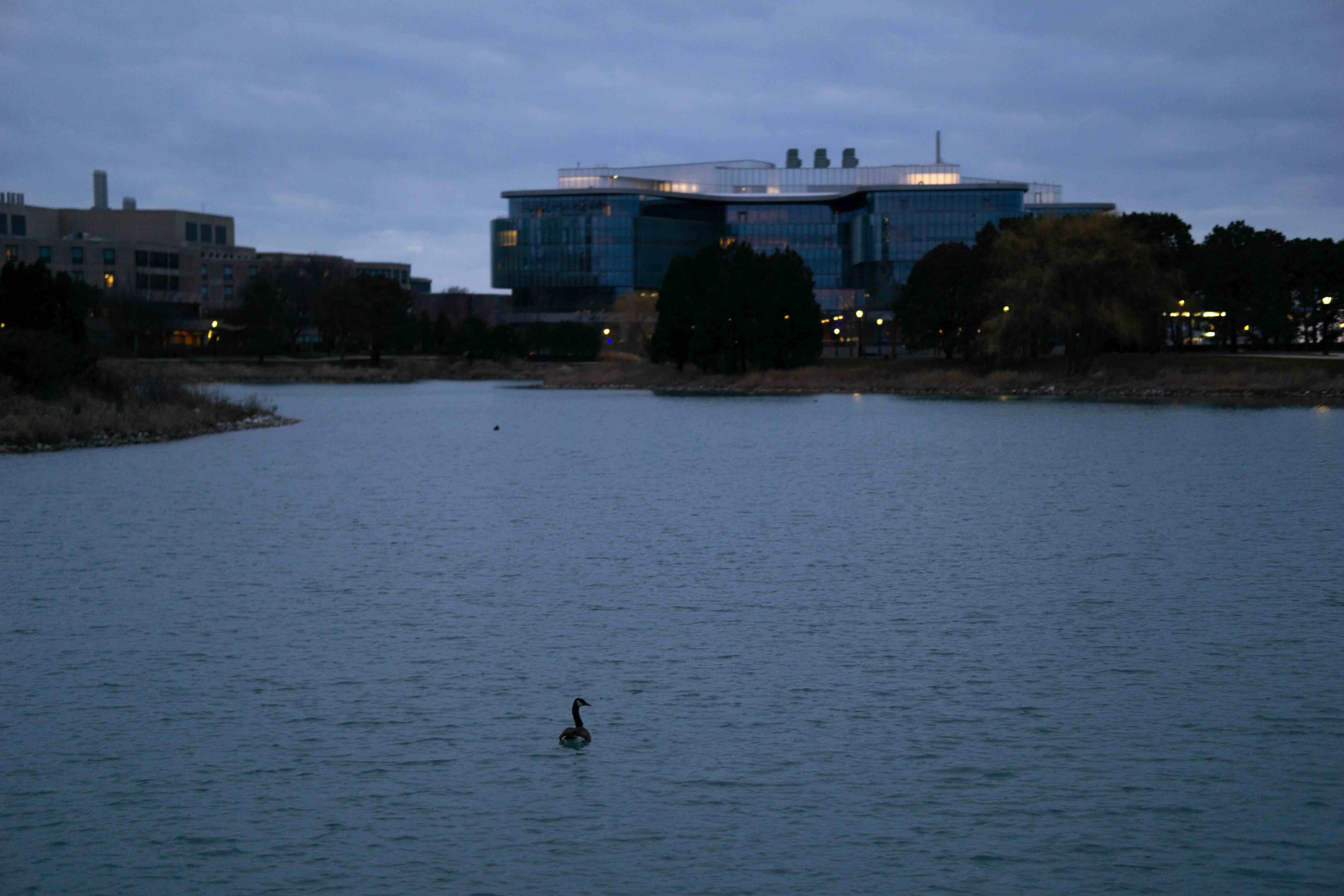
Yet, despite their prevalence on Northwestern’s lagoon today, this wasn’t always the case.
“The crazy thing about Canada geese is that back in the 1950s, people thought that the large, non-migratory Canada goose was extinct,” said John Bates, Curator of Birds at the Field Museum.
Bates pointed to the research of Harold Hanson, who wrote a book called “The Giant Canada Goose” where he described how people tried to reestablish Canada geese across the United States.
“It was a spectacular success from the Canada goose perspective,” Bates said. “So all those non-migratory Canada geese that are here year-round are actually descended from those 100 birds in Rochester, Minnesota in 1950.”
A prominent ornithological study published in Science in 2019 found that 2.9 billion birds have vanished since 1970. An even more recent study published in Science on Feb. 26, 2026, found that a large part of North American bird populations are not just declining, but declining faster than expected. Stotz, whose work focuses on conservation, highlighted how this accelerated decline could be due to both habitat loss from agricultural intensity and housing development, as well as agricultural practices becoming less suitable to birds. But he also added a caveat — this decline of bird populations is not applicable to all types of birds. And to Bates, looking at the stories of individual bird species like the Canada goose brings him hope that various other species can recover.
Eli Suzukovich III, who teaches Northwestern’s Maple Syrup and Climate Change class, said that over the years, he has kept an eye on winter birds and the change in bird species on campus.
“Right now, when the sap starts flowing, we get goldeneye ducks predominantly, and we get some buffleheads,” Suzukovich said. “And in the last couple of years, students and myself, we've only seen like maybe three pairs, nothing major. If we go back to the 90s and the 80s, you would have had like a couple 100 pairs out in the lake in January or February. These were common Chicago winter ducks.”
While bird watching data on iNaturalist tends to be a record of human activity as much as one of birds, an analysis of research-grade sightings of buffleheads shows that the number of buffleheads spotted in Cook County has been generally decreasing since 2021.
“The last 10 years since I've been doing maple tapping, the most I've ever seen at once — and it was a very cold winter — was 12 pairs,” Suzukovich said. “That was like for a day, and then they were gone.”
Suzukovich said that the decline of these ducks appearing on the lagoon could be due to a number of factors, such as changed flight patterns or the weather being too warm for an arctic duck. But he’s noticed another pattern in a different species.
The common merganser is a duck for which Cornell Lab of Ornithology’s All About Birds guide has an entry for: females have “rich, cinnamon heads with a short crest,” while males have “clean white bodies, dark green heads and a slender, serrated red bill.”
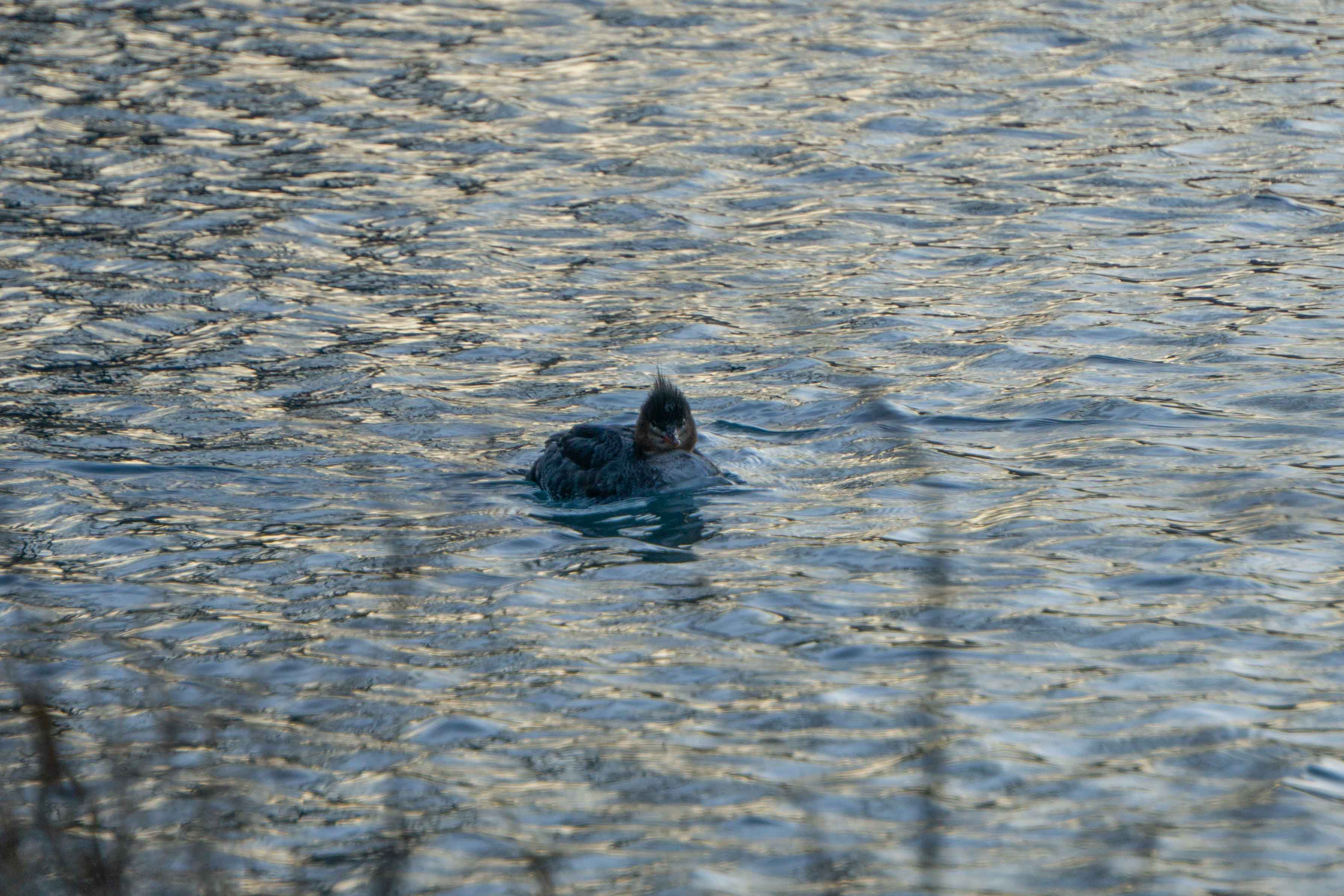
“I don't know exactly what prompted it, but you see more of these common mergansers than you used to, and it does also seem to coincide with warmer and unpredictable winters,” Suzukovich said.
Suzukovich said that he thinks Canada geese, too, have enjoyed Northwestern’s slightly warmer winters. Bates said there are migratory populations of Canada geese across the Canadian Arctic, and then there are the geese that don’t migrate in the continental United States.
That’s what Weinberg junior Zach Wolk has noticed, too.
Wolk likes Canada geese. On Northwestern’s version of the social media app Fizz, he’s become known as the “Goose Whisperer.” He even has a stuffed Canada goose sitting in his living room — a mini-model of the real thing that Wolk admits might not be the most true-to-life, yet still shows the cheek patches that he uses alongside other features like a goose’s number of offspring to distinguish Evanston’s Canada geese.
In the fall and spring, when the geese are around, he visits them once a day, a few times a week, at Evanston’s Arrington Lagoon and around Northwestern’s lagoon. And despite recent construction, he said that over the past three years, he hasn’t observed any significant difference in the number of Canada geese.
“I feel like I know them so well,” Wolk said. “I’m looking forward to seeing which geese nest around the mini lake this year.”
Stotz, too, is excited about an upcoming event.
“There’s nothing better than spring migration,” Stotz said. “It’s about to be the best time of year.”
Methodology
I gathered bird species data, bird hotspot data and Canada geese numbers through the eBird API 2.0. I used Python’s request library to extract the data, then worked with either Python, R or Flourish, depending on the specific dataset, to wrangle, analyze and visualize the data. I also used iNaturalist to find bufflehead numbers. Additional information on my approach toward each specific data finding is below.
Tools Used:
- Python — requests, pandas, time
- R — tidyverse (including ggplot2 and dplyr), tigris, janitor, sf, ggrepel
- React and Gatsby — to build this site
- Other — Flourish, RStudio, Jupyter Notebook, GitHub Pages, Adobe Lightroom Classic
1. “There have been 490 unique bird species spotted in Cook County, according to eBird data.”
- Using the eBird API 2.0, I requested the number of bird species seen in Cook County, which only looks at species list (spplist) and doesn’t exclude any records based on dates. This gets a complete collection of all birds spotted, dating back to eBird’s beginnings in 2002.
2. “Bird watchers have recorded bird sightings in practically all corners of the county, with Montrose Point Bird Sanctuary and Northwestern University proving to be particularly fruitful locations.”
- Using the eBird API 2.0, I requested the bird hotspots of Cook County, which only looks at hotspots and doesn’t exclude any records based on dates. This gets a complete collection of bird hotspots, dating back to eBird’s beginnings in 2002.
3. Data visualization: Bird hotspots of Cook County
- Using the eBird API 2.0, I requested the bird hotspots of Cook County. Then I used Flourish to plot every place a bird was spotted, playing around with the opacity such that hotspots would have more circles and thus appear darker on the map.
4. “Canada goose numbers in Cook County have been holding steady — for the past five years, bird watchers have spotted an average of 29 geese a day around the shores of Lake Michigan.”
- Using the eBird API 2.0, I requested all Canada geese numbers reported for every single day in Cook County from 2020 to now (Feb. 23, 2026). I appended these numbers to a CSV as they were pulled, ensuring that if something happened during the three hours it took to pull all 2,247 observations, I could go back and fix particular dates that were missed or pulled incorrectly. Then I imported this CSV into RStudio and summarized the mean to find the average number of Canada geese spotted per day in Cook County.
5. Data visualization: Canada geese numbers remain steady in Cook County
- Using the same Canada goose dataset as the one I created from the eBird API 2.0, I made this line chart to show the daily Canada goose counts in Cook County, averaged per month. I initially tried to plot every data point, but the line chart quickly got clustered from the 2,247 observations and looked more like a horizontal ink blob than a data visualization. So instead, I averaged the Canada goose counts per month and graphed those. The visual representation of the steady, cyclical trend in the number of Canada geese in Cook County showed that their numbers have remained steady from 2020 to the present.
6. “While bird watching data on iNaturalist tends to be a record of human activity as much as one of birds, an analysis of research-grade sightings of buffleheads shows that the number of buffleheads spotted in Cook County has been generally decreasing since 2021.”
- I filtered iNaturalist for “bufflehead” and “Cook County, IL,” then exported only the research-grade observations. These observations were for all bufflehead sightings in Cook County that iNaturalist had ever collected, which dates back to 2008. I then imported this CSV into RStudio, pulled the year and month each bufflehead was sighted, and did a similar data wrangling process as with the Canada geese numbers, where I averaged the bufflehead counts per month and graphed those. I decided against adding the final graph for bufflehead numbers into the final data story because it would have left the story too visually cluttered, but the line chart and my data wrangling process are in the Quarto file of this GitHub project. The visualization showed that the number of buffleheads spotted in Cook County has been generally decreasing since 2021.